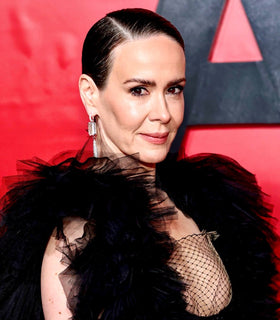
By the end of the third episode of American Horror Story Season 13, Sarah Paulson has already played two characters. The first is Cordelia Goode, still the Supreme, still sensing something wicked coming. The second is Ms. Wilhemina Venable, standing in the basement of the Apollyon and welcoming a group of living people to what she calmly calls a portal to Hell.
That second entrance is the moment the season stops being a reunion and starts being a system.
What Happens at Club Hell
After Constance’s Rauhnacht gathering upstairs, Elizabeth Short is given a final drink of the same eggnog used to drug Ben and then sent downstairs with Adelaide, Tate, Kai, and Winter. They believe they are going to a fashionable New York speakeasy. The elevator takes them into the basement of the building.
Venable is already there. She does not explain herself. She does not soften the news. She tells them they are at the portal to Hell. Elizabeth is taken for what the surrounding dialogue has already framed as part of a larger ritual involving 13 leading ladies.
The sequence is short and deliberate. No long monologue. No origin story. Just the former tyrant of Outpost 3 standing at a threshold and confirming that the Apollyon sits directly above something far older and more permanent than a haunted apartment building.
Why Venable, Not Cordelia
Paulson’s first appearance in the season is as Cordelia, still operating from Miss Robichaux’s Academy, still trying to interpret the signs. That version of Paulson is the moral center of the witches. Venable is the opposite. In Apocalypse she ran Outpost 3 with sadistic precision, enforcing rules, punishing desire, and treating survival as a privilege she alone controlled.
Putting Venable at the portal is a casting choice with weight. The character who once decided who lived and died in a post-nuclear bunker is now the gatekeeper of an actual entrance to Hell. The continuity is not forced. It is functional. Venable already understood hierarchy, purity, and the management of bodies. Club Hell simply gives her a larger jurisdiction.
The Vertical Design of the Apollyon
Season 13 has quietly built a clear vertical structure. On the 13th floor lives Mr. Nas, cared for by Constance and now by Ben. In the middle floors the building looks like an ordinary (if unsettling) residence. In the basement is Club Hell and the portal.
Venable’s presence locks that structure into place. She is not visiting from another season for a cameo. She is stationed at the bottom of the building the entire story has been circling. Every trip Ben makes between the street and the penthouse now carries the knowledge that something is waiting underneath.
That knowledge changes how the earlier episodes read. The black sludge, the horns, the distant massacres that feed Nas — all of it sits above a door that Venable is already guarding.
Paulson’s Multiple Roles Are Not Decoration
Ryan Murphy has said Paulson is playing six or seven characters this season. Venable is only the second to appear, but the pattern is already clear. The roles are not random. Cordelia is the one trying to stop whatever is coming. Venable is the one already inside the machinery. The remaining roles will almost certainly continue that division of labor rather than simply stacking fan favorites.
For an actress who has played more characters across this franchise than almost anyone else, the choice of Venable as the second reveal is telling. It is not the warm return. It is the one that confirms the season is willing to put its most controlling and least sentimental Paulson character in charge of the threshold.
FAQ
Does Sarah Paulson play Wilhemina Venable in Season 13?
Yes. She appears as Venable in the third episode, “Rauhnacht,” welcoming the group to the portal beneath the Apollyon.
What is Club Hell?
It is the space in the basement of the Apollyon that Venable identifies as a portal to Hell. Characters initially believe it is a speakeasy.
Is this Paulson’s second role in the season?
Yes. She first appears as Cordelia Goode. Venable is her second confirmed appearance in the opening three episodes.
Did Venable die in Apocalypse?
Yes. She was shot by Miriam Mead near the end of that season. Her return in living form is part of the larger pattern of resurrections running through Season 13.
Why does Venable’s presence matter more than a simple cameo?
Because she is positioned as the active gatekeeper of the portal rather than a visiting reference. Her role suggests the season’s mythology is already operational, not merely assembling.
Venable’s appearance at the bottom of the Apollyon is the cleanest statement Season 13 has made about its own ambitions. The reunion is not happening in a vacuum. It is happening above a door that someone is already holding open. And the person holding it is the last character anyone would expect to offer hospitality.
Why Venable at the Portal Changes the Season’s Power Map
Wilhemina Venable has always been bureaucracy with teeth. Placing her at the threshold of Club Hell is not a cameo flex. It is a statement about how Season 13 understands damnation: not as chaotic spectacle alone, but as procedure. Someone has to greet the delivered. Someone has to name the place without poetry. Venable is built for that sentence.
When Elizabeth Short arrives expecting a speakeasy and meets a portal instead, the cruelty is administrative. Constance selected. The younger group escorted. Venable received. The machine works because each role stays in lane. In a crossover crowded with legends, the character who turns Hell into a check-in desk may be the most frightening kind of return the franchise can still do.
Watch how often the show lets her speak plainly. American Horror Story sometimes hides menace under camp. Venable’s usefulness is the opposite. If the portal is real, the season needs a voice that refuses to romanticize it. That is why her position under the Apollyon matters more than another hallway scare.