Quick answer: Camp David is the secluded presidential retreat in Maryland’s Catoctin Mountain Park, and it is also the name permanently associated with the 1978 summit between U.S. President Jimmy Carter, Egyptian President Anwar Sadat and Israeli Prime Minister Menachem Begin. The 13-day meeting produced two framework agreements on September 17, 1978, which helped lead to the Egypt-Israel Peace Treaty signed at the White House on March 26, 1979.
What is Camp David?
Camp David is the official presidential retreat in Maryland’s Catoctin Mountain Park. It is deliberately secluded and is not open to the public. The National Park Service describes it as a place for presidential recreation, reflection, private meetings and hosting distinguished guests.
The retreat began during the Franklin D. Roosevelt era. President Dwight D. Eisenhower renamed it Camp David in 1953 after his grandson, David, and the official transfer to the federal government took effect in 1954.
Its location is part of its purpose. Camp David is close enough to Washington, D.C., for rapid presidential travel, but isolated enough to provide a controlled setting away from the normal public pressures of the capital. Presidents have used it for private time, working sessions, meetings and diplomacy.
The National Park Service history of the presidential retreat documents Camp David’s continuing role.
Why was Camp David chosen for the 1978 peace talks?
By 1978, Egypt and Israel had fought several wars and remained divided over territory, security and the wider Arab-Israeli conflict. Carter wanted a setting where Sadat and Begin could negotiate away from the public pressure and diplomatic formality of Washington.
The secluded environment became especially useful when the three-way negotiating format became difficult. Carter and his advisers met separately with Egyptian and Israeli delegations and carried proposals between them. This became a form of shuttle diplomacy inside the retreat itself.
The summit ran from September 5 through September 17, 1978. The U.S. State Department's historical record documents the summit as an important breakthrough while showing that difficult negotiations continued afterward before the final treaty was completed.
Who met at Camp David in 1978?
- Jimmy Carter — President of the United States and host and mediator.
- Anwar al-Sadat — President of Egypt.
- Menachem Begin — Prime Minister of Israel.
Senior diplomats, advisers and security officials were also involved. Their work translated political decisions into language that governments could negotiate, interpret and implement.
What were the Camp David Accords?
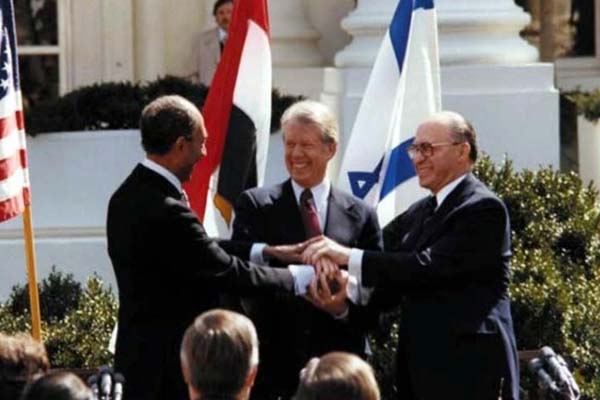
The Camp David Accords were two framework agreements signed on September 17, 1978, by Sadat and Begin, with Carter witnessing the agreement.
The first, A Framework for Peace in the Middle East, addressed principles for a broader settlement, including the future of the West Bank and Gaza and a proposed process for Palestinian participation in determining their future.
The second, A Framework for the Conclusion of a Peace Treaty between Egypt and Israel, laid out the basis for an Egypt-Israel peace treaty, including Israeli withdrawal from Sinai, security arrangements and normalization of relations.
The distinction matters: the Camp David Accords were framework agreements, not the final Egypt-Israel peace treaty. The treaty followed months of additional negotiations and was signed in Washington on March 26, 1979.
The U.S. State Department’s Office of the Historian provides the diplomatic timeline and historical documents.
What did the 1978 agreements actually address?
Sinai Peninsula
The Egypt-Israel framework provided for the restoration of Egyptian sovereignty in Sinai and a phased Israeli military withdrawal. It also established the idea of security zones and limitations on forces and armaments as part of the future peace arrangement.
Normalization between Egypt and Israel
The framework anticipated normal relations between the two countries, including recognition, diplomatic relations and the end of economic boycotts. These provisions were developed further in the 1979 treaty.
West Bank and Gaza
The broader framework addressed Palestinian self-government in the West Bank and Gaza and envisioned a transitional process followed by negotiations over final status. This part of the package became one of the most debated aspects of the agreement because the framework for Palestinian autonomy did not produce a final settlement of the Israeli-Palestinian conflict.
United Nations resolutions
The Camp David framework referred to United Nations Security Council Resolutions 242 and 338 as part of the diplomatic basis for negotiations. Those resolutions had become central reference points in attempts to establish a political settlement after the 1967 and 1973 Arab-Israeli wars.
How did Camp David lead to the 1979 Egypt-Israel peace treaty?
- September 5–17, 1978: Carter, Sadat and Begin negotiate at Camp David.
- September 17, 1978: Two framework agreements are signed.
- Late 1978 to early 1979: Egyptian and Israeli negotiators work through detailed treaty language, maps, security arrangements and normalization provisions.
- March 26, 1979: The Egypt-Israel Treaty of Peace is signed at the White House.
- Afterward: The treaty provides for Israeli withdrawal from Sinai and normal diplomatic relations between Egypt and Israel.
The treaty was therefore the product of a process that began at Camp David but continued beyond the retreat. The U.S. historical record shows that post-summit negotiations dealt with withdrawal, security zones, normalization and the relationship between the Egypt-Israel treaty and the proposed West Bank-Gaza process.
Why were the negotiations so difficult?
The parties were negotiating several connected issues at once: Sinai, Israeli security, Egyptian sovereignty, settlements, Palestinian self-government, borders and the wider Arab-Israeli conflict.
The historical record shows that the three-way format became difficult to maintain. Carter increasingly met separately with Egyptian and Israeli officials and carried proposals between the two sides. White House diaries and diplomatic records show how much time was spent rewriting language and resolving differences that could affect how an agreement would later be interpreted.
One of the less visible lessons of Camp David is that diplomatic breakthroughs often depend on painstaking work over wording, sequencing and implementation rather than a single dramatic meeting.
What happened to Sinai after Camp David?
The 1979 treaty established a phased Israeli withdrawal from Sinai and restored Egyptian sovereignty over the peninsula. It also established security arrangements and limits on military forces in specified areas.
Sinai is one of the clearest examples of a Camp David framework being converted into detailed treaty obligations. The diplomatic process continued until the parties had agreed on the legal and security architecture needed for implementation.
Did Camp David resolve the Israeli-Palestinian conflict?
No. The Camp David agreements addressed Palestinian self-government and proposed a process for negotiations involving the West Bank and Gaza, but they did not create a final Israeli-Palestinian peace settlement or resolve the questions that remain central to that conflict.
This distinction is essential when discussing the legacy of Camp David. The Egypt-Israel track produced a peace treaty. The broader framework concerning the Palestinians did not produce an equivalent final agreement.
The U.S. State Department’s archival documents show that the relationship between the Egypt-Israel treaty and the West Bank-Gaza negotiations was itself a major point of disagreement during the months after the summit.
Camp David’s wider presidential history
The retreat’s importance did not begin with the 1978 accords. The National Park Service notes that the site has been associated with major presidential activities, including World War II-era planning, meetings involving President Dwight Eisenhower and Soviet leader Nikita Khrushchev, discussions during the Kennedy administration and Vietnam-related discussions during later administrations.
Its role has shifted with circumstances. Sometimes it has been a private retreat; at other times it has functioned as a secluded workplace, diplomatic meeting site or crisis-management location.
That combination explains why “Camp David” can mean both a physical presidential retreat and the diplomatic agreements that emerged from the 1978 summit.
Camp David in 2026: why the retreat is back in the news
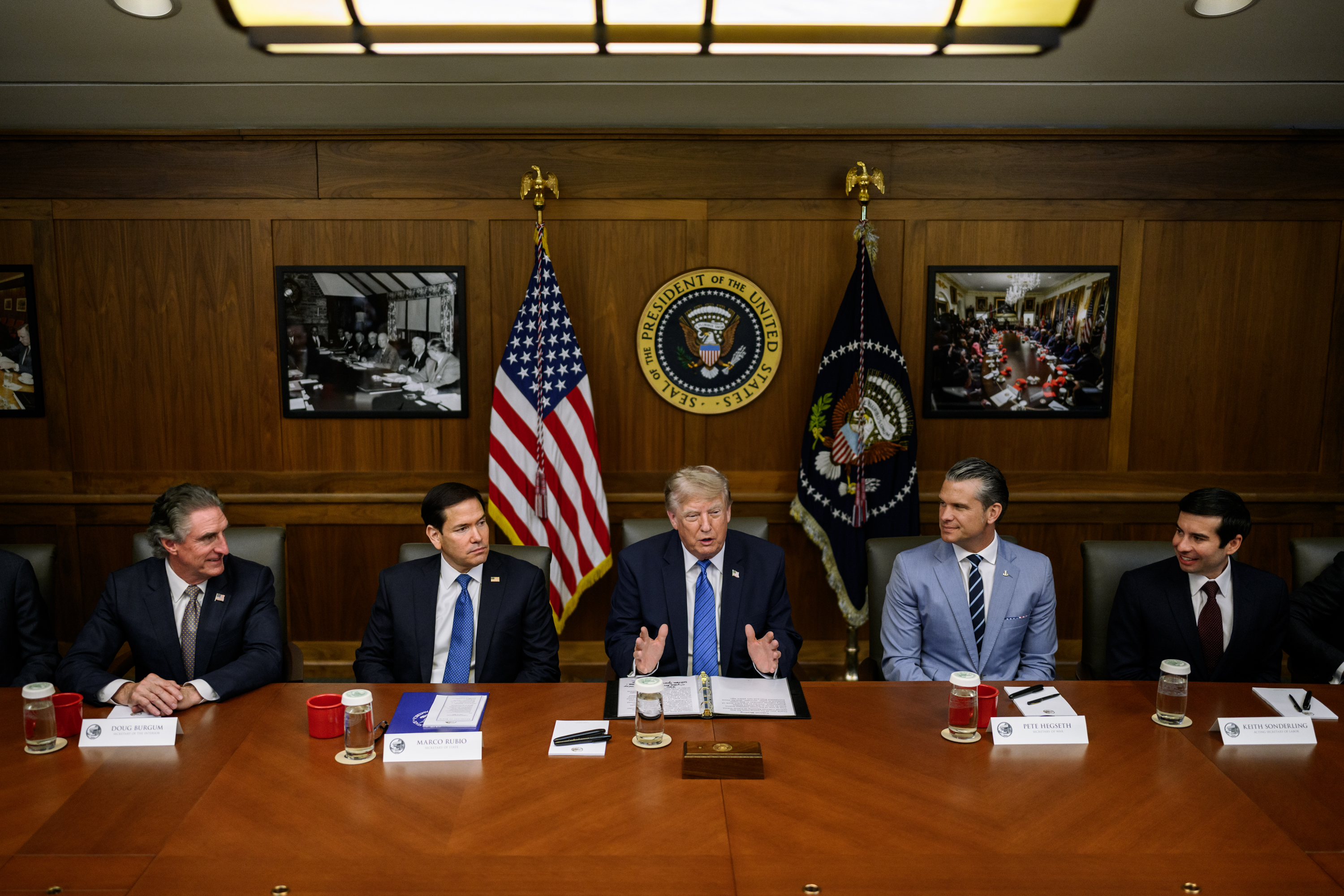
Camp David remains active. On July 31, 2026, President Donald Trump held a Cabinet meeting there that the White House described as the first live, televised Cabinet meeting at Camp David.
On September 19, 2026, while Trump was staying at the retreat, a NORAD F-16 intercepted a general-aviation aircraft that entered restricted airspace over Thurmont, Maryland. Contemporary reports citing NORAD and military officials said flares were used to attract the pilot’s attention and the aircraft was safely escorted out. The First Air Force also urged pilots to check current Notices to Airmen before flying near temporary flight restrictions.
The incident highlights a basic feature of Camp David that can be overlooked in its diplomatic history: it is a secure presidential facility with special airspace restrictions, including additional temporary restrictions when the president is present.
The incident was reported as an airspace violation; available reports did not indicate that the aircraft was treated as an attack on the presidential retreat.
What makes Camp David different from the White House?
The White House is the president’s public workplace and the center of the executive branch. Camp David serves a different function. Its physical isolation allows a president to work, meet guests and hold discussions with fewer of the visual and logistical pressures associated with the capital.
That difference was particularly important in 1978. The retreat gave Carter, Sadat and Begin a controlled environment in which negotiations could continue for nearly two weeks. The setting did not remove political pressure, but it changed the conditions under which the negotiators worked.
Camp David Accords vs. Egypt-Israel Peace Treaty
| Feature | Camp David Accords | Egypt-Israel Peace Treaty |
|---|---|---|
| Date | September 17, 1978 | March 26, 1979 |
| Location | Camp David, Maryland | White House, Washington, D.C. |
| Purpose | Framework for further negotiations | Formal bilateral peace agreement |
| Sinai | Framework for withdrawal and security | Detailed treaty provisions |
| West Bank and Gaza | Framework for transitional self-government negotiations | Did not become a final Israeli-Palestinian settlement |
A simple Camp David timeline
- 1940s: The presidential retreat is established in Maryland’s Catoctin Mountains.
- 1953: Dwight Eisenhower renames the retreat Camp David.
- September 5, 1978: The Camp David summit begins.
- September 17, 1978: Two framework agreements are signed.
- March 26, 1979: Egypt and Israel sign their peace treaty at the White House.
- 1981: Anwar Sadat is assassinated by Islamist militants opposed to the peace process and other policies; the treaty remains in force.
- July 31, 2026: Trump holds a televised Cabinet meeting at Camp David.
- September 19, 2026: A NORAD fighter intercepts an aircraft that entered restricted airspace near the retreat while Trump is there.
Why the Camp David story still matters
Camp David is often reduced to a famous photograph or a single phrase about peace. The deeper story is more complicated. The 1978 summit shows how diplomacy can involve private negotiations, repeated revisions, separate meetings and political trade-offs before a framework is ready for public announcement.
It also shows the difference between an agreement that creates a negotiating framework and a treaty that establishes detailed legal obligations. The Camp David Accords created the path. The 1979 Egypt-Israel treaty supplied the detailed bilateral settlement.
More than four decades later, the retreat remains a working part of the presidency. That continuity gives Camp David an unusual place in American history: it is simultaneously a physical location, a presidential institution and the name attached to a diplomatic process that changed the relationship between Egypt and Israel.
Watch: Camp David and the 1978 peace negotiations
Social post and primary-source trail
Pilots! @NORADCommand fighter aircraft intercepted an aircraft violating restricted airspace over Thurmont, MD, resulting in flares being deployed. Make sure to check NOTAMs before takeoff to ensure you have current information about TFRs in your area. Stay Safe, Fly Informed!
For the historical record, readers can compare official diplomatic documents with presidential and National Park Service materials. The U.S. State Department’s 1979 treaty record, the National Park Service Camp David archive, and the National Park Service history of the retreat provide useful institutional and primary-source context.
Frequently asked questions about Camp David
Where is Camp David?
Camp David is in Catoctin Mountain Park in Maryland, northwest of Washington, D.C. It is a private presidential facility and is not open to the public.
Why is Camp David famous?
It is famous both as the U.S. presidential retreat and as the location of the 1978 Camp David Summit that produced the framework leading to the Egypt-Israel Peace Treaty of 1979.
Who signed the Camp David Accords?
Egyptian President Anwar Sadat and Israeli Prime Minister Menachem Begin signed the two framework agreements, with U.S. President Jimmy Carter witnessing them.
Were the Camp David Accords the same as the 1979 peace treaty?
No. The accords were framework agreements signed in September 1978. The formal Egypt-Israel Peace Treaty was signed at the White House on March 26, 1979.
What did Egypt receive from the Camp David process?
The Egypt-Israel framework provided for the restoration of Egyptian sovereignty over Sinai and a phased Israeli withdrawal, alongside security arrangements and normalization between the two countries.
Did Camp David create a Palestinian state?
No. The 1978 framework addressed transitional self-government and negotiations concerning the West Bank and Gaza, but it did not establish a Palestinian state or settle the Israeli-Palestinian conflict.
Can the public visit Camp David?
No. The National Park Service states that the presidential retreat remains private and is not open to visitors.
Is Camp David still used by presidents?
Yes. Camp David remains the presidential retreat and continues to be used for private presidential time, meetings and official work.
What happened at Camp David on September 19, 2026?
While President Donald Trump was staying at the retreat, a NORAD F-16 intercepted a general-aviation aircraft that entered restricted airspace near Camp David. Military officials said the aircraft was safely escorted away and that flares were used to attract the pilot’s attention.
Sources and further reading
- U.S. Department of State, Office of the Historian — Camp David
- U.S. Department of State — Camp David framework documents
- U.S. Department of State — 1979 Egypt-Israel Peace Treaty record
- National Park Service — Presidential Retreat
- National Park Service — A Pathway to Peace
- The White House — July 2026 Camp David Cabinet meeting
Updated September 19, 2026, using U.S. Eastern Time for the current-events section. Historical claims are based primarily on U.S. government and National Park Service records; current security-incident details are attributed to military officials and contemporary reporting.