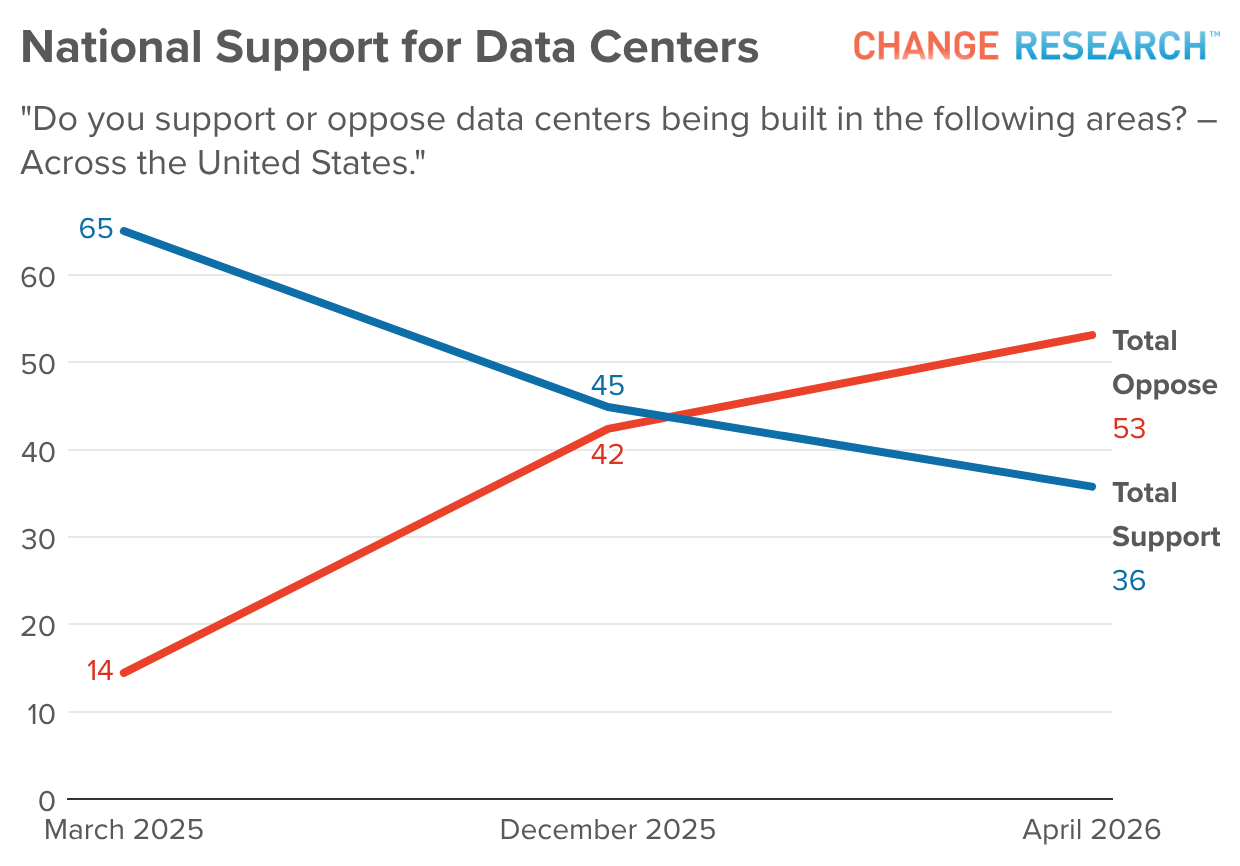
Quick answer: A nationally representative Annenberg Public Policy Center survey found that 61% of U.S. adults opposed building new data centers in their communities, up from 49% in the survey conducted earlier in 2026. The survey also found that views about AI’s overall impact were comparatively stable, showing a gap between attitudes toward AI as a technology and attitudes toward large physical infrastructure projects.
The key distinction: AI use versus local infrastructure
The APPC survey found that 59% of respondents had used or interacted with AI at least a few times in the previous month, while 61% opposed new data centers in their area. That contrast suggests that acceptance of AI tools does not automatically translate into support for the infrastructure required to run them.
Why data centers create a different debate
Unlike a software product, a large data center has a physical footprint. Communities may have to consider electricity demand, grid upgrades, water use, land, construction activity and local tax or rate impacts. These are neighborhood-level questions even when the technology being served is global.
The survey was bipartisan
The APPC survey reported opposition among 69% of Democrats, 54% of Republicans and 53% of independents. The sample included 1,320 U.S. adult citizens and was fielded from June 16 through July 19, 2026, with a stated margin of error of ±3.5 percentage points for the full sample.
AI optimism does not eliminate local concerns
APPC reported that views of AI’s broader effect on the United States had not shifted significantly over the same period. The survey found 39% expected AI’s impact over the next decade to be negative and 18% expected it to be positive, while 68% said the government had done too little to regulate AI.
The infrastructure question policymakers face
The practical issue is increasingly about who bears the cost of rapid computing expansion. If new facilities require major transmission, generation or water infrastructure, communities and regulators have to decide how those costs should be allocated.
What this means for AI companies
Data-center development depends on more than chips and capital. Projects also need electricity, suitable land, permits and community acceptance. Local resistance can therefore become a constraint on the speed at which AI infrastructure expands.
Frequently Asked Questions
What percentage of Americans opposed new local data centers?
The APPC survey reported 61% opposition among U.S. adult citizens surveyed.
Does this mean most Americans oppose AI?
No. The survey separately measured attitudes toward AI and attitudes toward building physical data centers nearby.
How large was the survey?
It included 1,320 U.S. adult citizens and was nationally representative after weighting, according to APPC.
Why are data centers important to AI?
They provide the computing, networking and cooling infrastructure needed to train and operate large AI systems.
Source: Annenberg Public Policy Center.
Author: Shivam Das